

From soil to health: making regenerative & healthy food the default
Insights from the Regenerative Agriculture Community & the Healthier Food Community break-out session
Innovation Insights 25 March 2026
Healthy food begins long before it reaches our plates. It starts in the soil, shaped by farming practices, processing methods and decisions made throughout the value chain on how to develop, refine, and bring a product to market.
During Innovation Insights: Eating the Change 2.0, hosted at the Friesland Campina Innovation Centre in Wageningen, one central question guided the conversation: how can we shift what feels normal, so that regenerative agriculture and healthy food choices become part of the mainstream?
The session, organised by the Foodvalley Healthier Food Community and the Foodvalley Regenerative Agriculture Community – endorsed by EIT Food, brought together different perspectives to explore possible answers.
Connecting health & regenerative agriculture across the system
A key theme throughout the session was the need for shared definitions. Terms like healthy soil, healthy food, and human health are often used interchangeably, yet they operate at different levels of the system. Professor Harro Bouwmeester from the University of Amsterdam (MicroHealth Research) examined the connections between soil, plant, and human health through microbiomes. Emerging research increasingly suggests that the influence of soil and plant microbiomes extends to crop quality, nutritional value (often referred to as nutrient density), and potentially, human health outcomes.

At the same time, this field is still developing. While tools are now available to examine these soil and health relationships in detail, translating scientific insights into practice requires alignment: shared definitions, consistent and careful communication. The challenge is how to align research, farming practices, product development, and consumer understanding.

Keeping it simple without losing meaning
Following the scientific perspective, a panel discussion explored what this means in practice. Panellists Jeroen Heck from FrieslandCampina, Anne van de Peppel from HarvestCare/ FoodPharmacy Programme, Michiel de Ruiter from EIT Food, Jens Hellewaard from Volksportret, and Harro Bouwmeester from the University of Amsterdam reflected on how to bring these insights to consumers. One clear message stood out: Keep it simple for the consumer.
According to EIT Food’s Healthier Lives Through Food insight report, storytelling is a powerful tool to help make complex systems understandable. However, panellists emphasised that stories must extend beyond packaging, into education, the supermarket experience, and everyday conversations. When narratives are reduced to on-pack claims, they risk oversimplifying reality or making health promises that cannot be substantiated.

One good standard instead of many “better” options
Rather than offering a range of “healthier” versions of the same products, the discussion pointed towards a different ambition: aiming for one truly good standard of product quality. This means raising the baseline and ensuring that the ‘default option’ is tasty, nutritious (nutrient-dense), and produced responsibly and regeneratively. Creating a spectrum of slightly improved alternatives only shifts the burden to the consumer, who is often under-informed and easily overwhelmed by a multitude of on-pack claims.
This insight was confirmed through the Volksportret AI panel, where consumers demonstrated limited knowledge when asked to choose healthy and sustainable options based solely on packaging. The results clearly showed that messaging alone is not enough to guide consumer choice.
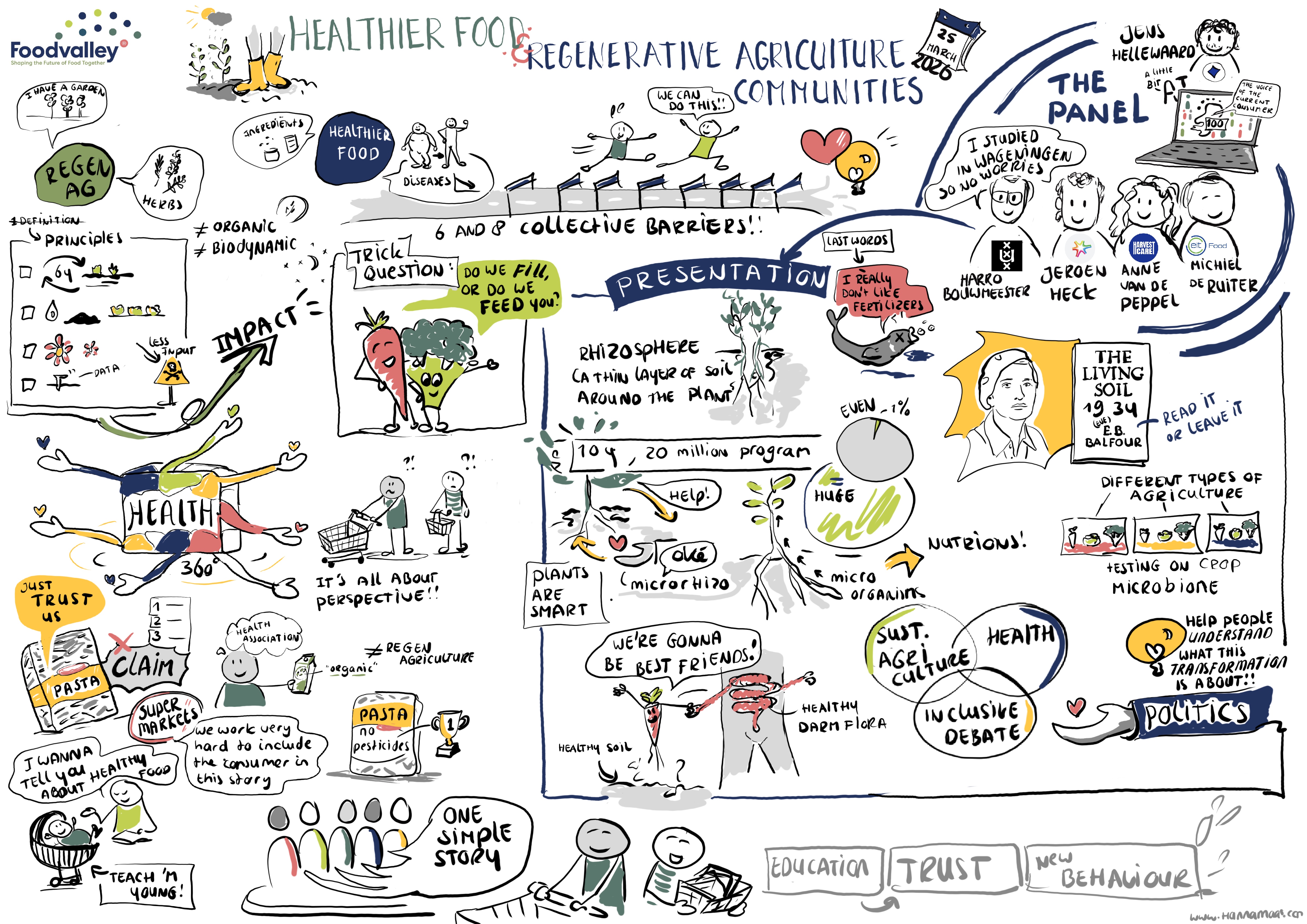
Instead, the value chain as a collaborating system must take responsibility for developing, producing, and selling healthier and sustainable food. It should not be left to the consumer to navigate crowded supermarket shelves in search of what nourishes them and is produced sustainably.
For this kind of systemic change to take root, farmers must be able to produce regeneratively. That requires increasing demand, fair payments, and supportive initiatives that demonstrate how this can work in practice and be scaled. A clear and consistent shared ambition to collaborate across the various value chains is indispensable. This is exactly where Foodvalley comes in. Together with partners, we work on, amongst others, the regenerative landscape initiatives, ReGeNL, the Regenerative Agriculture Transition Map, and the Living Labs. This is where we showcase how it can be done and how to scale for impact.
Moving the needle together
The transition towards regenerative agriculture and healthier food is not about quick fixes. It is about aligning the entire value chain around this shared goal. Everyone needs to take their role with leadership and ambition. This also means taking collective responsibility, defining clear definitions, using common language, and telling honest, clear stories that resonate with consumers.
By working across disciplines and roles, the food system can evolve towards solutions that support soil health, resilient farming, nutrient-dense food, and long-term human wellbeing.

Join the movement
At Foodvalley, we work with partners across the value chain, from farm to fork, to turn this shared ambition into action. Through our communities like the Regenerative Agriculture Community and the Healthier Food Community, partners connect, learn, and collaborate on initiatives that showcase innovative, scalable solution pathways, backed by regime players and real-world implementation.
Did you get inspired by this Innovation Insights community break-out session, and would you like to join the movement?