
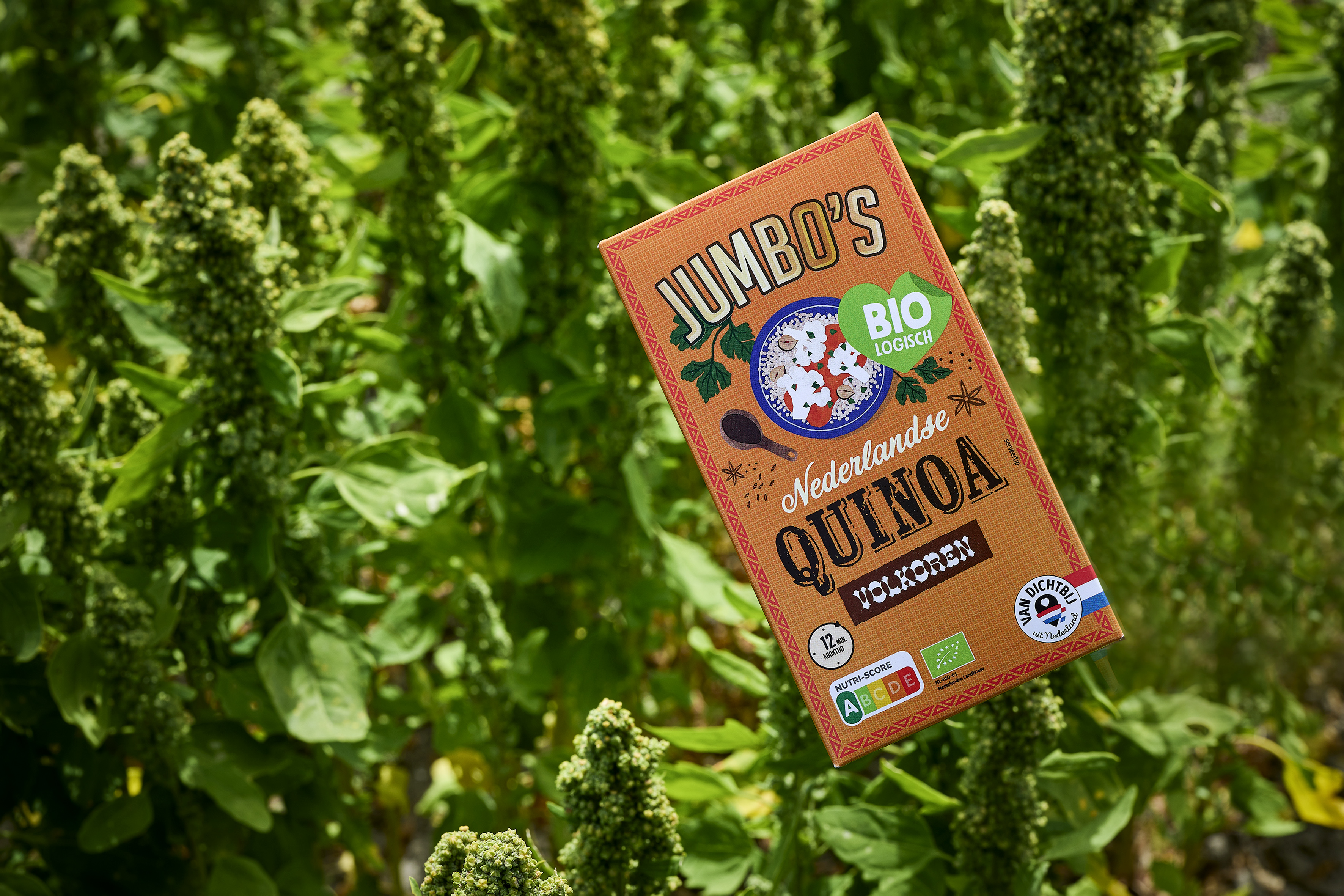
Dutch-grown quinoa reaches Jumbo shelves
Dutch-grown quinoa is now available in Jumbo supermarkets across the Netherlands. A tangible result of what Plant Protein Forward is all about: creating the market conditions that allow locally grown crops to move from potential to practice.
In the video, pioneering quinoa grower Govert van Dis, Jumbo Category Manager Kirsten van Galen and Marc Arts, CEO and founder of GreenFood50, explain how Dutch-grown quinoa reached supermarket shelves and what it took to build the value chain behind it.
Note: In the video, quinoa is referred to as ‘protein-rich’. Nutrition claims such as ‘high protein’ are regulated under EU legislation and depend on the nutritional composition of the specific product. The term is therefore not used here as a product claim.
More than a different country of origin
At first glance, it is a simple change on the supermarket shelf: quinoa that was previously sourced internationally is now grown by Dutch farmers.
But there is more to it.
The quinoa supplied by GreenFood50 and sold under Jumbo’s own brand is Dutch-grown, organic and, importantly, wholegrain. The varieties used are naturally low in saponins, the bitter compounds found on the outside of quinoa seeds. This means less processing is needed to remove the outer layer, allowing the quinoa to retain its wholegrain character and the fibre-containing outer layers of the seed.
This gives Dutch-grown quinoa an interesting nutritional proposition, but the crop is relevant from an agricultural perspective too.
Quinoa is known for its ability to cope with challenging growing conditions, including saline soils, although tolerance differs between varieties. With salinisation becoming an increasing challenge in parts of Dutch agriculture, that resilience adds to the potential of quinoa as a crop for the future.
From promising crop to viable market
Agricultural potential alone, however, is not enough.
For farmers, introducing a new crop only becomes attractive when there is a credible market for it. Growing something successfully is one thing; having buyers, sufficient volumes, long-term agreements and a viable business case is another.
That is the challenge Plant Protein Forward addresses.
Plant Protein Forward was initiated by Foodvalley, Rabobank and the Provincial Protein Network NL to help scale and professionalise value chains for Dutch-grown crops rich in protein and fibre.
Foodvalley contributes its transition expertise, market knowledge and ecosystem; Rabobank brings its network and business perspective, with a strong focus on true value; and the provinces help build regional and national support for new value chains.
Together, they connect farmers, processors, food companies, retailers and foodservice organisations around concrete market opportunities.
Rather than starting with a crop and hoping that demand will follow, Plant Protein Forward starts by connecting existing or emerging market demand with local production opportunities.
Quinoa: from market opportunity to supermarket shelf
Quinoa is a good example of how this approach can work.
Market research by Foodvalley and Circana showed growing retail demand for products containing quinoa, while quinoa sold in the Netherlands was still largely sourced internationally. At the same time, GreenFood50 and Dutch growers had the knowledge and potential to increase local production.
The opportunity was clear: could more of the existing demand be supplied by Dutch farmers?
With support from value chain facilitator (ketenversterker) Rocus Troost, that opportunity was converted into a concrete market proposition, ultimately leading to a long-term market commitment with Jumbo sourcing its own-brand organic quinoa from twelve Dutch growers.
For the farmers involved, that long-term demand matters. It provides greater confidence to invest in cultivation and quality. For Jumbo, it creates a more local and transparent supply chain. And for the wider protein transition, it provides a practical example of how local crops can move beyond pilots and become part of mainstream food retail.
Building the next value chains
Quinoa is one result, but Plant Protein Forward is not about a single crop or product.
The programme is developing and strengthening value chains for a range of Dutch-grown crops. Earlier collaborations helped Dutch edamame and soy-based products reach the market, while new value chains for crops such as buckwheat and seaweed are now taking shape.
Each value chain is different, but many of the challenges are the same: creating sufficient demand, connecting the right partners, sharing risks, building long-term commitment and ensuring fair value distribution.
That is why involvement from the market is crucial.
Are you looking for opportunities to source more Dutch-grown plant-based ingredients? Or are you working on, or connected to, a crop value chain with untapped growth potential?
Plant Protein Forward is looking for partners who want to turn that potential into viable, long-term value chains.
Together with Foodvalley, Rabobank, the Provincial Protein Network NL, growers and value chain partners, you can help move the next Dutch-grown crop from field to market.

Curious to know more about Plant Protein Forward? Visit the Plant Protein Forward web page or contact Marleen de Jonge, Project Lead Plant Protein Forward at Foodvalley, via Marleen.dejonge@foodvalley.nl