Inside the landscapes: accelerating regenerative agriculture transition in
practice
Insights from the Regenerative Agriculture Community Acceleration Session on 18 June 2026
What does it take to develop regenerative agriculture transition projects at landscape level in practice? And how to balance different stakes in landscape development?
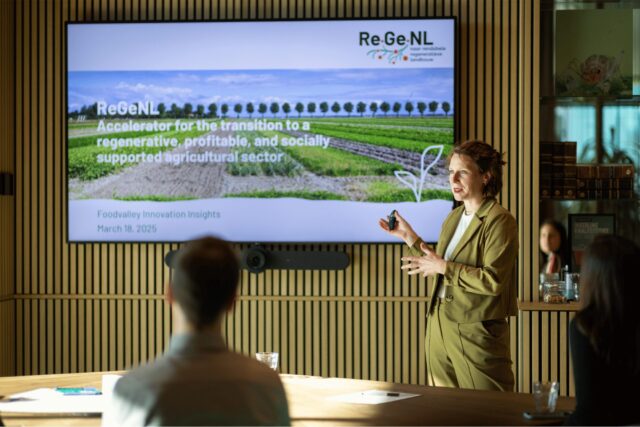
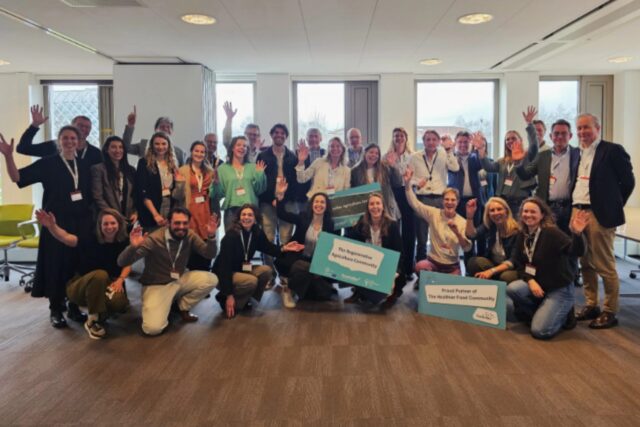
These questions guided a recent session of the Regenerative Agriculture Community. Participants active in landscape projects across Europe, explored how different stakeholders varying from farmer to large off takers can organise themselves around shared goals while dealing with different interests, risk appetite, financial possibilities, timelines and responsibilities.
A shared system with different perspectives
A landscape is a bioregion based on similar ecological characteristics and challenges. Initiatives working in landscapes bring together actors operating within that bioregion. This includes farmers, agri-food companies, financiers, water partners, public actors, communities – all have a relation to the landscape and are interdependent of one another. A landscape initiative allows all these stakeholders to collaborate towards regeneration of the landscape. This is crucial, because all the landscape stakeholders have a different role to play.
To illustrate, farmers need a fair income and markets for diversified products and landscape management. Agri-food companies depend on stable supply and demand. Water companies and water boards need effective water management for and by farmers and industry. Working at landscape level means these perspectives need to be aligned in a positive way for all.
When you go alone you go faster, when you go together you go further.

Learning from initiatives already underway
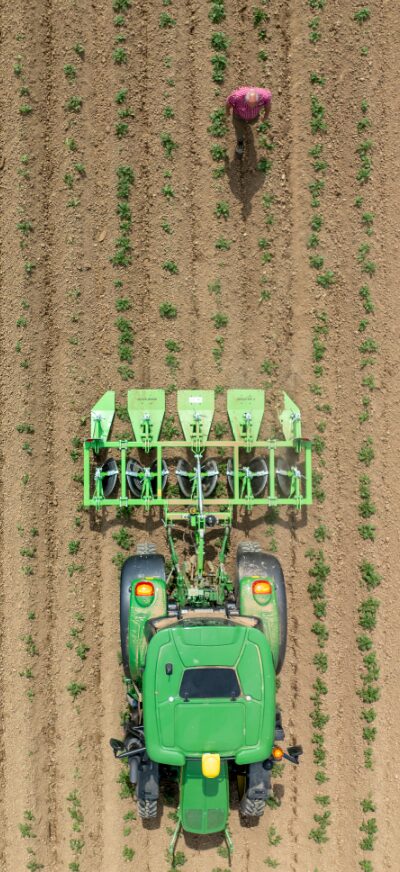
The session included concrete examples of landscape initiatives, including in Lower Silesia, Poland and in the Hoeksche Waard, the Netherlands. These examples showed how collaboration takes shape in practice.One of them was developed, starting from a market angle. The other one is starting from a broader coalition around the landscape. What they have in common, is that they start with alignment around shared ambitions. From there, activities are developed to support and de-risk farmers in their transition.
This is not an easy task. Neutral transition coordination in these (often commercially sensitive) discussions are key and requires continuous effort. Creating trust and reaching alignment between partners does not emerge automatically. It needs committed partners, clear roles and responsibilities and a structure that supports and de-risks long-term landscape development.
How to approach scale and ambition
A key topic discussed was how to build towards scale and ambitious outcomes.
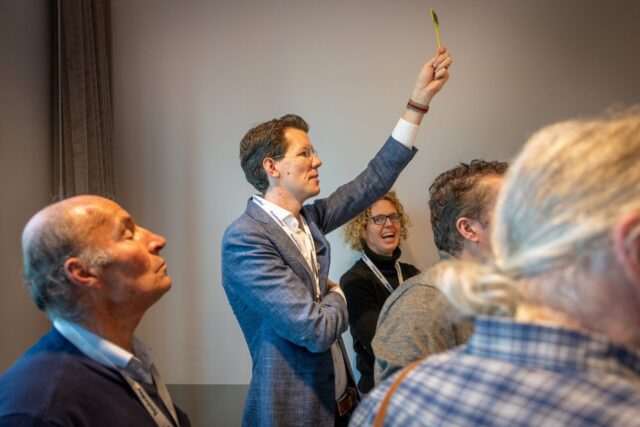
As showed in the pictures below, several approaches were discussed. Some initiatives start with a limited group of farmers with high ambitions, and expand over time. Others work with a larger group from the beginning and introduce regenerative practices step by step.
The discussion highlighted that bold steps need to be taken to scale regenerative agriculture. By taking these bold steps, you feel how the system responds. If it will push you back or allows you to move forward.
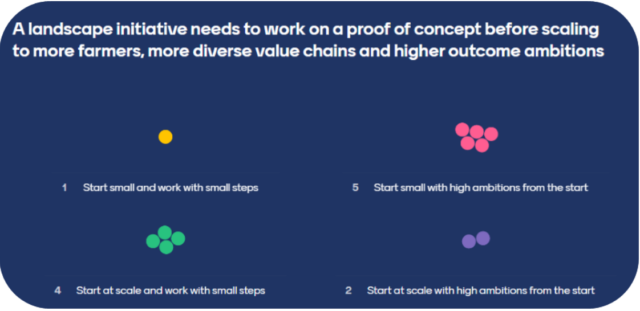
Picture from a statement exploring the topic of scale & ambition in a landscape initiative
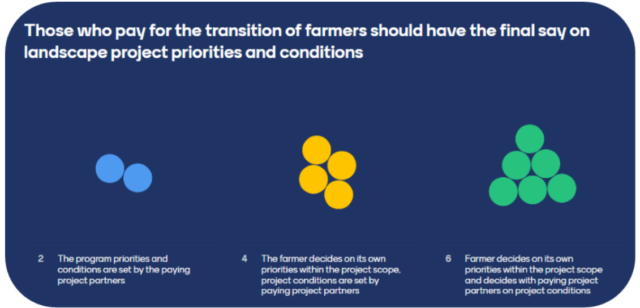
Picture from a statement exploring the topic of agency in a landscape initiative
How decisions are made
Another key topic discussed was agency in landscape initiative decisions. When multiple stakeholders are involved, each contributing time, resources, risk or financial resources, the question comes up: ‘who decides on what’.
Participants agreed that landscape partners need to work hand-in-hand with farmers. When farmers decide on their priorities, you do not only work collaboratively, but also more efficient.
There was consensus in the room that saying ‘who pays, decides’ is too simple. Farmers should have agency over decisions that affect their land and operations. Motivation is crucial! But value chain partners also need a clear project scope, reporting and reliability. Financial contributors require accountability. How does this translate in the priorities and governance of landscape initiatives in practice? Balancing these perspectives is not straightforward, but it is essential for building trust and sustaining collaboration.
A landscape approach is not a one-size-fits-all recipe
The discussion showed that there is no fixed model for landscape development. It is a learning journey to organise collaboration within a shared ecosystem. This approach makes it possible to address challenges that cannot be solved at field, farm or supply chain level alone. It connects environmental and livelihood and financial outcomes to economic realities and creates the conditions for farmers to scale regenerative practices. At the same time, it requires continuous coordination, adaptation and alignment across stakeholders. This is where neutral conveners like Foodvalley come in and play a crucial transition accelerating role.
Join our journey:
We’re always looking for like-minded innovators!
The Regenerative Agriculture Community invites organisations to engage, share insights and contribute to the development of landscape initiatives in practice. The community creates a safe space to collectively explore approaches and questions, connecting European stakeholders working on similar challenges to share experiences and develop practical initiatives.
By sharing and discussing dilemmas openly, the community helps to increase the collective knowledge of regenerative value chains and landscape stakeholders across Europe.
The Regenerative Agriculture Community is a breeding ground for new practical regional collaborations and initiatives in Europe.
Reed more via this link: The Regenerative Agriculture Community – Foodvalley
Fill in the form and we will invite you for a personal or joint e-meeting to explore collaboration.
For partners of the Resilient Agriculture Portfolio, participation in the community is free in 2026!
If your organisation is working on or exploring landscape approaches, this is the place to connect and co-create with likeminded partners!