
Marjolein Brasz, CEO Foodvalley
For years, I have been driven by two questions. How can we learn to live and work within the limits of our planet, using resources in ways that restore rather than deplete? And how can we turn promising initiatives into change that spreads, takes root and becomes the new normal?
Those questions led me from oil & gas, to renewable energy, to circular economy, and they still shape the way I work today.
From transition theory to practice
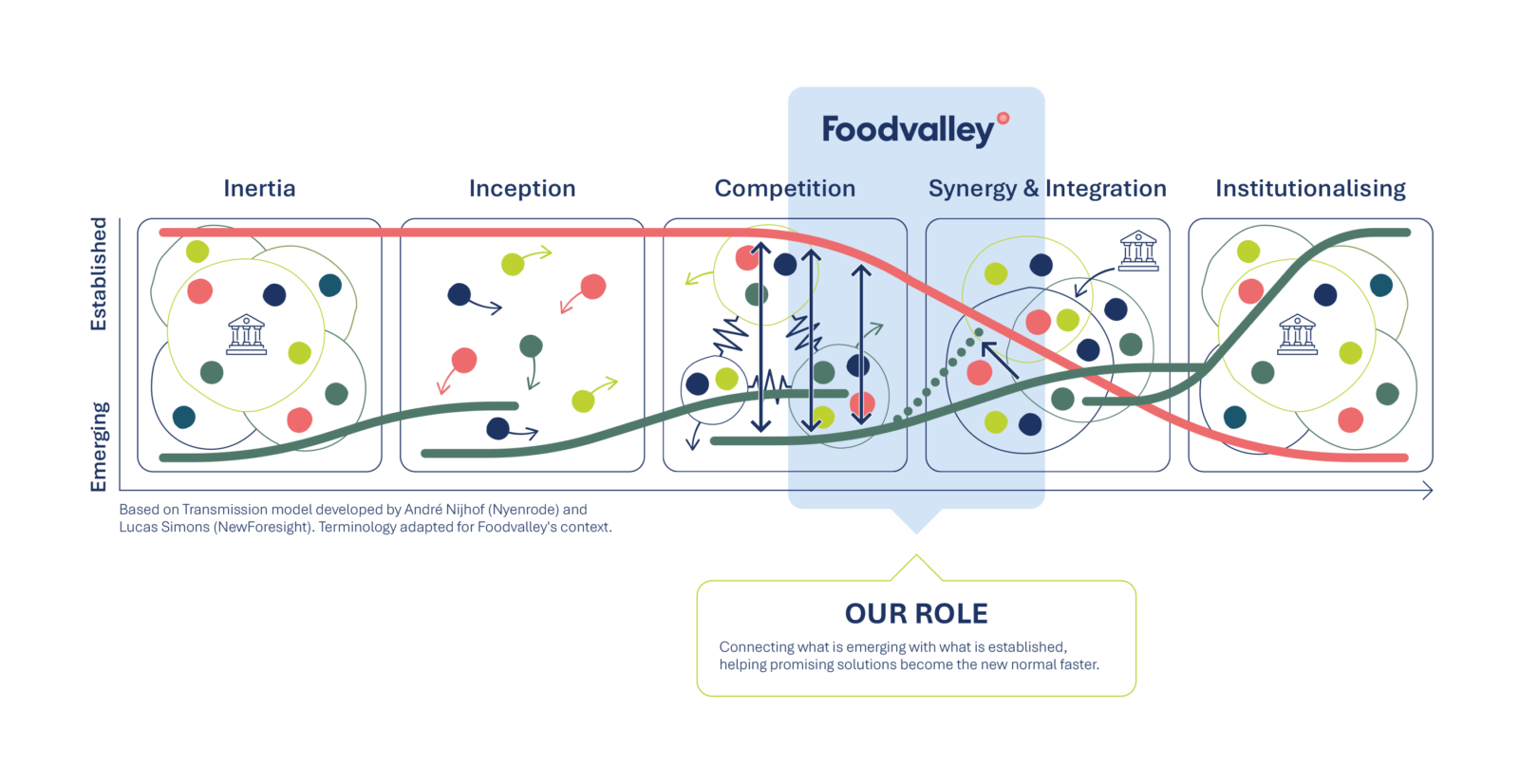
The Club of Rome was already asking similar questions in 1972. Later, I became fascinated by the work of Jan Rotmans and DRIFT’s X-Curve, Margaret Wheatley’s thinking on relationships and roles, and the way the Transmission Model, developed by André Nijhof (Nyenrode) and Lucas Simons (New Foresight), visualises how solutions move through a system.
Working in the Amsterdam Metropolitan Area on a large-scale circular programme, I learned how new markets take shape. The technology was often already available. The real challenge was overcoming the barriers that kept promising solutions from reaching the market, whether for recycled diapers, roadside grass, organic food waste, e-waste or other circular resources: procurement rules designed for existing products, investors waiting for demand, and buyers unwilling to move first. Momentum grew when producers, buyers, policymakers and investors started addressing these challenges together. Looking back, this experience shaped the way I think about change.
What attracts me to models is their practical value. A good model provides a shared perspective. It helps us recognise where a system is on its journey and understand what is needed next. In a sense, models are sexy!
The Transmission Model, for example, describes a journey from inertia to inception, competition, synergy and eventually institutionalisation. Each phase requires something different. Context matters. Knowing where an emerging solution is on that journey is every bit as important as having a clear direction.
Over the years, these models helped me make sense of the patterns I kept seeing in practice. They gave me a language for understanding how change unfolds and what it takes for emerging solutions to become part of everyday life. They also helped shape the role we play at Foodvalley.
Foodvalley: where system change becomes real
At Foodvalley, we bring transition theory and real-life practice together. Twentytwo years of food innovation, combined 50+ years of transition work, thousands of conversations, dozens of initiatives and a strong international network of more than 500 partner organisations have shaped the way we work today. Together, we are shaping a fair and just food system.
Along the way, one thing has become increasingly clear: there is no shortage of ideas, energy or people willing to act. New solutions emerge everywhere. Farmers explore new and rediscovered practices. Product developers create upcycled ingredients. Retailers test how far they can go whilst continuing to serve today’s customers. Investors look for opportunities to support change. All over the food system, people are already moving. Creativity, ambition and determination are everywhere.
The challenge is helping promising solutions become part of everyday life. A recurring sale. A new dish. A new habit. On the journey from emergence to widespread adoption is where Foodvalley feels most at home.
This summer I had the time to step back and reflect on our role and where we fit best. When the pace slows down, even slightly, whether on a bike or floating on the IJlake, new patterns become visible. Summer is a wonderful time to challenge assumptions, reconnect the dots and sharpen strategic choices.
Over the years, we have built trusted relationships across the food ecosystem. We understand the realities of farmers, food entrepreneurs, product developers, retailers, researchers, investors, civil servants and bankers. And when we don’t, we eagerly ask, listen, learn and explore.
The aim is to create a place where people can come as they are, meet openly, share, challenge and work on shared ambitions. Where newcomers bring new ideas, energy and fresh perspectives, and established organisations bring vast experience, knowledge, infrastructure, networks and capital.
Knowing both worlds allows us to connect what is emerging with what is established. That is where momentum grows. And where scaling becomes possible.
In many ways, we hold the space where change can take shape.
Today, we describe our approach through three simple principles:
01 SEEING WHAT IS NEXT
By working closely with partners across the food system, we identify opportunities emerging from our network and communities, consumer and market trends, geopolitical developments and economic shifts.
02 BUILDING COLLECTIVE ACTION
Where momentum is building and the potential for impact is significant, we build focused coalitions and connect promising initiatives with established value-chain partners.
03 SCALING WHAT WORKS
We empower agents of change within established organisations, helping successful approaches move from pilot to everyday practice and enabling emerging solutions to become the new normal.
A board that reflects the system
Collaboration across the food system is essential for change. That same breadth of perspective should also be reflected in our own organisation, we know😊. That is why I am delighted to welcome three new members to the Foodvalley Board.
Peter Ploegsma (CFO Wageningen University & Research) combines his financial expertise with a strong connection to the knowledge ecosystem. He brings valuable perspectives on the role of science and society in transition processes.
Diederik Slot (Country Manager Porticus) strengthens our perspective through his experience in philanthropy. Diverse funding streams and strong partnerships allow us to focus on the areas where change can have the greatest potential.
Peter de Roos (CEO Lidl Netherlands) brings deep retail experience and a strong understanding of consumer behaviour. He knows what it takes to make healthy and sustainable food accessible and affordable.
Together, they add new valuable new perspectives to our Board from science, philanthropy and retail. Their experience helps us ask different questions, recognise opportunities and navigate an increasingly complex landscape.
People change systems
In the end, people change systems. Those who are curious about the perspectives of others and who are willing to step beyond their own organisation, sector or discipline.
Models help us understand the journey. People make it happen.
Welcome Peter, Diederik and Peter!
Please find an interview with all three via the button below.