Regulations as a driver for upcycled food: from bottleneck to accelerator
Insights from the Acceleration Session organised by The Upcycling Community
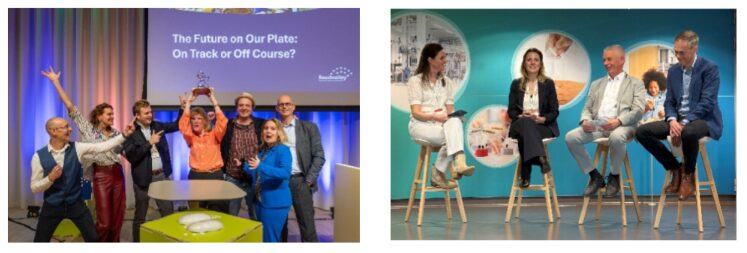
On June 4 2026, The Upcycling Community of Foodvalley hosted an acceleration session in collaboration with the Nederlandse Vereniging Circulaire Economie (NVCE), exploring a pressing topic for upcycled food: the role of regulation..
Over the past years, regulatory frameworks have repeatedly emerged as both a driver and a barrier to the development of the upcycled food market and have been discussed often in The Upcycling Community. Through community events, including the development of a Position Paper published two years ago, a recent session in December and cross-sector dialogues such as the roundtable at the National Conference on Circular Entrepreneurship, Foodvalley and its partners have worked to better understand these dynamics. A consistent insight has been that circularity in food is still not sufficiently embedded in policy agendas, highlighting the need for stronger awareness, clearer guidance, and more coordinated advocacy.
Recognizing that advocacy requires dedicated expertise and positioning, Foodvalley has started to explore collaboration with organisations such as NVCE, which play a leading role in advancing the circular economy in the Netherlands. This session marked the starting point of that collaboration, bringing together stakeholders to explore how regulation can move beyond being perceived as a barrier and instead actively stimulate demand for upcycled food and ingredients, and accelerate the transition as a whole.
During the Acceleration session, participants explored how regulation could actively stimulate demand for upcycled food and ingredients, rather than slow down innovation.
A shared challenge: navigating the regulatory ‘grey zone’
For many organisations in the upcycling ecosystem, regulation had long been a key challenge. Existing EU frameworks were not designed with upcycled food in mind, creating uncertainty for companies aiming to bring innovative solutions to market.
At the same time, different regulatory domains, including food, feed, waste and circular economy, intersected in complex ways. As a result, upcycled ingredients often operated within a “grey zone”, lacking clear categorisation or harmonised standards.
This resulted in delays in bringing products based on side streams to market, risk-averse interpretations by authorities, uncertainty around “end-of-waste” pathways, and a lack of clear standards and benchmarks.
These challenges were widely recognised within The Upcycling Community. Earlier discussions had already highlighted the need to better define bottlenecks, identify common patterns across sectors, and jointly shape solutions.
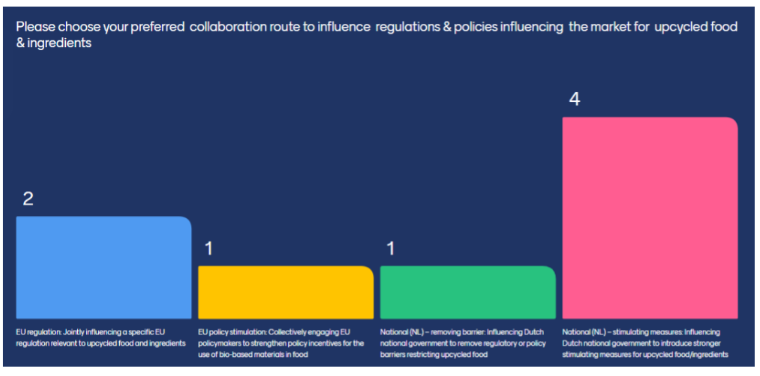
Outcomes of our session, based on Menti scores
Regulation as a factor in market demand
Beyond compliance challenges, regulation also played a direct role in shaping market uptake. Buyers increasingly showed interest in upcycled ingredients, but often felt insufficiently enabled by the regulatory framework to act with confidence. This led to increased perceived risks around sustainability claims, limited incentives to scale demand, and hesitation among larger buyers and foodservice organisations.
At the European level, policy frameworks such as waste legislation, general food law and the novel food regulation were key in shaping the possibilities for upcycling. However, current policies are still more focused on waste reduction than on actively creating demand for circular ingredients.
From constraint to opportunity
A central theme of the session was how regulation could shift from being perceived as a constraint to becoming a market-shaping instrument. Taking a forward-looking perspective, participants explored how policy can actively stimulate market development, rather than merely control it.
Insights shared during the session reinforced that the availability of side streams is not the primary bottleneck; supply is abundant. The real challenge lies in creating stable and scalable demand. If regulation is intentionally designed and repositioned as a market-shaping tool, it can play a key role in unlocking this demand and moving upcycled ingredients from niche to mainstream.
Several concrete policy directions were discussed:
· Rewarding circular solutions by creating financial advantages over linear alternatives
· Disincentivising the use of non-circular ingredients
· Introducing minimum shares of circular or upcycled ingredients in product categories or public procurement
In this context, regulation can act as a demand accelerator, particularly when combined with clear standards and definitions, sustainable procurement criteria, and robust safety and quality frameworks.
Taken together, these perspectives highlight that regulation, if aligned with market needs, can actively shape the playing field and accelerate the transition towards circular food system
The importance of collaboration
A key takeaway from the session was the importance of collaboration across the value chain. The complexity of the regulatory landscape meant that no single organisation could address these challenges alone.
By bringing together partners from The Upcycling Community with the NVCE, the session combined practical industry insights with expertise in policy and advocacy. Participants explored shared priorities for policy engagement, identified opportunities for collaboration, and discussed how to translate identified bottlenecks into concrete input for policy dialogues.
Aligning perspectives across food, feed, waste and circular economy domains emerged as a key step towards building a more coherent and enabling framework.
Looking ahead
The acceleration session marked an important step in exploring collaboration between industry and policy stakeholders. By combining insights from The Upcycling Community with the advocacy expertise of the NVCE, the session helped to build a shared understanding of both barriers and opportunities. Turning regulatory complexity into collective action will be essential to unlock the full potential of upcycled food in Europe.
Join the Movement
Inspired but not part of the Upcycling Community yet?
Learn more about The Upcycling Community and its ongoing initiatives. Read more and get in touch with us. Read more and get in touch with us.